Chinchero: Weaving, Terraces & the High Plateau
The 'birthplace of the rainbow' on the plateau above the Sacred Valley — its living weaving tradition, the church built on Inca foundations, the terraces, the Sunday market, and how the new airport and a valley loop fit around it.

Photo: Sophia Simoes / Unsplash
- ✓Chinchero sits high on the plateau between Cusco and the Sacred Valley, around 3,760 m — higher than Cusco, so pace yourself here.
- ✓It's the great centre of living Andean weaving: cooperatives demonstrate the whole process, from washing raw wool to natural dyeing and back-strap looms.
- ✓The adobe colonial church stands on a vast Inca platform and terraces attributed to the Inca ruler Túpac Yupanqui — Inca foundations under a 16th-century church.
- ✓A new international airport is being built nearby, long debated for its impact on the valley — check the current status as it changes the access picture.
The birthplace of the rainbow
Chinchero spreads across a windswept plateau between Cusco and the Sacred Valley, a town of adobe houses and dry-stone walls looking out over terraces toward the snow peaks of the Vilcanota range. Local tradition calls it the birthplace of the rainbow, and on a clear afternoon after rain you understand why — the light here is enormous, the horizon ringed with glaciers, the colours of the weavings echoing the sky. It is one of the most atmospheric and least rushed stops in the whole region, partly because most tours give it less time than it deserves.
What sets Chinchero apart from the other Sacred Valley towns is that its great tradition isn't a ruin to be photographed but a craft still practised daily. This is one of the heartlands of Andean weaving, where the knowledge of spinning, natural dyeing and patterning has been handed down unbroken, and where you can watch it happen rather than only buy the result.


The weaving cooperatives
The reason most people remember Chinchero is the weaving. Several community cooperatives in and around the town give live demonstrations of the full process, and a good one is genuinely fascinating: raw sheep or alpaca wool washed with the root of the saqta plant, which lathers like soap; the fleece spun by hand on a drop spindle; the yarn dyed with natural materials — cochineal insects for crimson and pink, the tara pod and local plants for yellows and greens, indigo for blue — the colours shifted before your eyes by adding a squeeze of lime or a pinch of salt; and finally the patient work at the back-strap loom, where intricate patterns are built thread by thread.
These demonstrations usually end at a spread of finished textiles for sale, which is fair enough — the sales support the weavers directly, and the quality of genuine Chinchero work is high. Prices are higher than the mass-market stalls because the work is real handwork in natural dyes, and that's exactly the point. If you only buy textiles in one place in the Sacred Valley, this is a strong contender for where to do it. A modest tip or fair purchase after a demonstration is good etiquette.
- Cooperatives demonstrate the whole craft: washing with saqta root, hand-spinning, natural dyeing and back-strap weaving.
- Natural dyes include cochineal (red/pink), tara and plants (yellows/greens) and indigo (blue) — colours shifted with lime or salt.
- Finished pieces cost more than market knock-offs because they're real handwork in natural dyes — and the money reaches the weavers.
- After a demonstration, a fair purchase or small tip is the courteous way to say thank you.

The church on the Inca platform
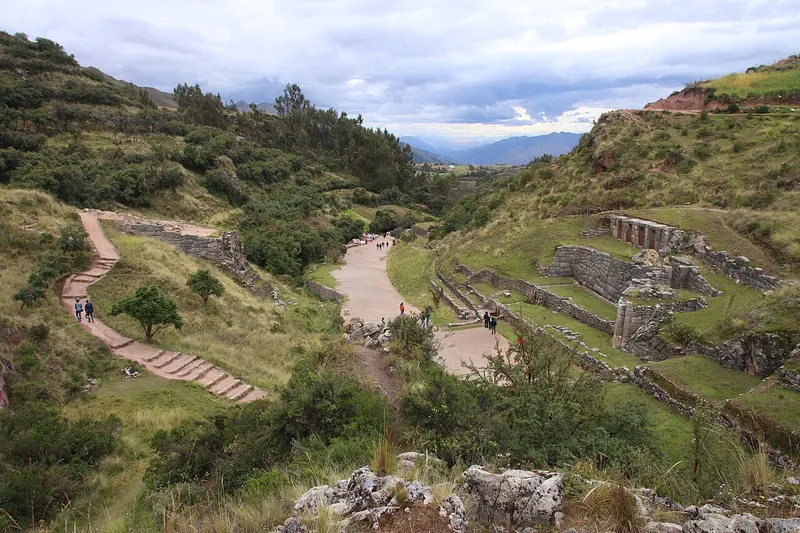
On the rise above the modern town stands Chinchero's colonial church, the Iglesia de Nuestra Señora de la Natividad, an unassuming adobe building that hides one of the loveliest painted interiors in the region — walls and ceiling covered in colourful 17th-century murals. It was built, like so much in Peru, directly on top of the Inca: the church sits on a massive Inca platform and palace foundations, with fine polished stonework and trapezoidal niches still visible in the surrounding walls. The site is associated with the Inca ruler Túpac Yupanqui, who is said to have had a royal estate here.
Below and around the church spread Inca agricultural terraces, broad and beautifully made, descending toward the plain. Walking down through them — past the old stone walls, the spring-fed water channels, and out onto the trails that lead toward the valley — is one of the quiet pleasures of Chinchero, and a reminder that the whole plateau was once an engineered landscape. Entry to the archaeological complex, including the terraces and the area around the church, is typically covered by the Boleto Turístico; verify its current scope and price locally.
- The adobe colonial church has a richly painted interior and stands on a huge Inca platform and palace foundations.
- The site is linked to the Inca ruler Túpac Yupanqui's royal estate — Inca stonework underpins the 16th-century church.
- Inca agricultural terraces and water channels spread below; walking down through them is a highlight.
- Entry to the complex is generally on the Boleto Turístico — confirm scope and price locally.
The Sunday market
Chinchero holds a market that is far less touristy than Písac's, with Sunday the traditional main day. It's smaller and rougher around the edges, more a working market for the surrounding communities than a souvenir bazaar, and that is its charm — alongside the textiles you'll find produce, household goods, and, in the old way, a degree of barter, where highland families trade goods rather than only cash. Going on a Sunday lets you combine the church, the terraces, the weaving cooperatives and the market in a single, unhurried visit.
Because Chinchero gets fewer of the big coach groups than the lower valley towns, even on market day it tends to feel calmer. If you want a Sacred Valley market with more local life and less polish than Písac, this is the one.
- The Sunday market is smaller and more local than Písac's, with real community trade and a touch of barter.
- Sunday lets you pair the market with the church, terraces and weaving demonstrations in one visit.
- Generally calmer than the lower-valley towns — fewer big coach groups.
The new airport — and why it matters
Chinchero is the planned site of a major new international airport intended to serve Cusco and the Sacred Valley, replacing the constrained current Cusco airport. The project has been under construction and has been one of the most debated developments in the region: supporters point to easier, possibly direct international access to the gateway of Machu Picchu, while critics — including heritage and environmental voices — have warned about the impact of a large airport on this fragile high plateau, its terraced landscape and the wider Sacred Valley.
For a traveller, the practical upshot is simply this: the access picture for the whole region may change once the airport opens, potentially with direct flights that bypass Lima, and Chinchero itself sits beside the works. Because timelines and status have shifted repeatedly, check the current state of the project rather than relying on any fixed date. Whatever happens, the town's weaving and its terraces remain the reason to stop.
- A major new international airport for the Cusco region is being built at Chinchero — long delayed and much debated.
- It could eventually allow direct international flights to the Machu Picchu gateway, bypassing Lima.
- Heritage and environmental concerns about its impact on the plateau and valley are significant.
- Status and timelines keep shifting — verify the current position before relying on it.
Fitting Chinchero into a Sacred Valley loop
Geography makes Chinchero an easy add-on. It sits on the high road between Cusco and Urubamba, so the classic move is to stop here first thing on the way down into the Sacred Valley — church, terraces and a weaving demonstration — before descending to the lower, warmer towns and the famous Maras and Moray sites. Many full-day Sacred Valley tours from Cusco open with Chinchero for exactly this reason, then carry on to Moray, the Maras salt pans, Ollantaytambo and sometimes Písac.
One altitude note worth repeating: at around 3,760 m, Chinchero is higher than Cusco and noticeably higher than the valley floor, so it's not the gentlest first stop if you've only just arrived. Save it for once you've adjusted, take the plateau wind seriously, and you'll have one of the most rewarding and least hurried half-days in the region.
- Chinchero sits on the high road between Cusco and Urubamba — a natural first or last stop on a valley loop.
- It pairs especially well with Moray and the Maras salt pans, a short drive on.
- At ~3,760 m it's higher than Cusco — save it for once you're acclimatized, and dress for plateau wind.
Practical notes and common questions
A handful of things worth knowing before you go. Chinchero is genuinely high and genuinely exposed, so the practical advice that matters most is about the body and the weather rather than the sights: come once you've adjusted to the altitude, dress in layers you can shed as the sun strengthens, and carry water and serious sun protection, because the combination of thin air and strong UV burns faster than the cool temperature suggests. The plateau wind can turn a sunny afternoon sharp in minutes.
On logistics: there's no need to pre-book a weaving demonstration as a rule — the cooperatives welcome drop-ins and tours alike — but a fair purchase or small tip afterwards is the expected courtesy. Bring cash in soles for the market, the weavers and any taxi. And if photographs of the weavers or market stallholders are what you're after, ask first and buy something; these are people at work, not exhibits.
- Is it worth a stop? Yes — for the living weaving tradition alone, plus the church, terraces and views.
- How long do I need? A half-day is comfortable: a weaving demonstration, the church and Inca platform, a wander through the terraces.
- Is it a hard visit? Easy walking, but it's high (~3,760 m) — go once acclimatized and pace yourself.
- When's the market? Sunday is the traditional main day; it's smaller and more local than Písac's.
- Cash or card? Bring cash in soles for the market, the weavers and taxis.
At a glance
The Chinchero essentials in one place. Its weaving and terraces are evergreen; the airport's status and ticket prices change, so verify those locally.
- What it is: a high plateau town famed for living Andean weaving, a painted church on Inca foundations, and terraces.
- Altitude: around 3,760 m — higher than Cusco; visit once acclimatized and dress for the wind.
- Don't miss: a weaving cooperative demonstration, the church and Inca platform, the terraces below.
- Market day: Sunday is traditional — smaller and more local than Písac's.
- Big change ahead: a new international airport is being built nearby — check its current status.
Related guides

Sacred Valley Itinerary: One or Two Perfect Days
A loop-by-loop Sacred Valley itinerary linking Písac, Urubamba, Maras and Moray, Chinchero and Ollantaytambo — paced for altitude and built to end at the train to Machu Picchu rather than back in Cusco.
Read guide
Moray: The Inca's Circular Terraces
The concentric terraced bowls on the plateau above the Sacred Valley — what they are, the leading theory that they were an Inca agricultural laboratory, the microclimates between the rings, how to get there, the Boleto Turístico, time needed, and pairing with the Maras salt pans.
Read guide
The Maras Salt Mines (Salineras de Maras)
The cascade of hand-worked salt-evaporation pools above the Sacred Valley — how the spring-fed pans work, the community that owns them, getting there, the separate entrance fee, photography and visitor etiquette, and pairing with Moray.
Read guideMore in Sacred Valley
6
Best Hotels in the Sacred Valley
A curated shortlist of where to sleep in the Sacred Valley before Machu Picchu — sorted by what each does best: shortest train day, gardens and acclimatization comfort, family space, honeymoon luxury and value.
Read guide
Family Hotels in the Sacred Valley
Where families should sleep in the Sacred Valley before Machu Picchu — garden resorts with lawns and pools, family rooms, easy meals, low-altitude comfort and smooth train-day logistics.
Read guide
Hiring a Private Driver in the Sacred Valley
When a private driver beats a group tour in the Sacred Valley — the flexibility, the off-road plateau sites, families and luggage, citadel-morning transfers, and realistic route ideas with honest timing.
Read guideLuxury Sacred Valley Hotels
The Sacred Valley's high-end lodges, spa retreats and honeymoon bases — destination hotels where pampering doubles as low-altitude acclimatization before Machu Picchu.
Read guideMaras & Moray: A Half-Day Route
A practical half-day plan for combining Moray's circular Inca terraces and the Maras salt pans — from Cusco or a Sacred Valley base. Transport options compared, the best order, timing for light and crowds, tickets, altitude notes and how to add it to a bigger valley day.
Read guide
Ollantaytambo: A Living Inca Town Guide
The Sacred Valley's most atmospheric staging base — a fortress town where the Inca street grid is still lived in, the train to Machu Picchu departs, and an early citadel morning becomes a short walk to the platform.
Read guide