
Písac Market: Textiles, Crafts & Etiquette
The famous artisan market in the Sacred Valley town of Písac — what to buy, how the timing and bargaining work, telling handwoven from machine-made, and how to fit the market and the hilltop ruins into one day.

Photo: Peter Livesey / Unsplash
- ✓Písac's market fills the plaza of a small Sacred Valley town about an hour from Cusco — alpaca knits, woven textiles, ceramics, silver and local produce.
- ✓There's a market most days now, but Sunday is the traditional big day, when the town is busiest and Quechua communities come down from the hills.
- ✓Genuine handwoven textiles cost more than the soft acrylic 'baby alpaca' you'll see everywhere — learn the tells before you pay for the real thing.
- ✓Most people pair the market with Písac's spectacular hilltop Inca ruins, reached on the Boleto Turístico — do the ruins first, the shopping after.
A market under the terraces
Písac sits where the Sacred Valley begins to open out, about an hour by road down from Cusco, its plaza ringed by adobe houses and pisonay trees and watched over by one of the most dramatic flights of Inca terraces in the whole region. The market that spills across that plaza is the one most travellers picture when they imagine an Andean market: trestle tables and canvas awnings heaped with scarlet and indigo weavings, towers of folded alpaca jumpers, beaded jewellery, painted gourds and ceramics, and — tucked among the souvenirs — the everyday produce and herbs the town actually runs on.
It has become a fixture of the Sacred Valley circuit precisely because it's so photogenic and so easy to reach, which means it can feel touristy at the height of the day. But linger past the front row of stalls, climb toward the produce end, and you find the older market still beating underneath the souvenir trade — bags of dried maize in a dozen colours, mountains of potatoes, bundled herbs, and the unhurried bartering of people who came to buy, not to browse.


When to go: Sunday, and the rest of the week
For decades Písac's market ran on the old three-day rhythm, with Sunday as the great day — the morning the surrounding Quechua communities walked down from the high villages to trade, in their best clothes, and when the town also held its Sunday mass in Quechua and the symbolic procession of the varayoc, the community leaders carrying their silver-topped staffs of office. Sunday is still the biggest and most atmospheric day, and the one to aim for if the traditional spectacle is what draws you.
The catch is that everyone else knows this too, so Sunday is also the most crowded, with tour buses arriving from Cusco mid-morning. These days there is a market most days of the week, so if you want the stalls without the crush, a weekday morning is calmer and the prices can be softer. Whichever day you pick, go early: the light is kinder, the vendors are fresher, and you'll beat the coach groups that thicken the plaza from late morning.
- Sunday is the traditional big market day — most atmospheric, most crowded, with the morning Quechua mass and the varayoc procession.
- A market runs most other days too, quieter and often cheaper — good if you want the stalls without the Sunday crowds.
- Go early either way: softer light, fresher vendors, fewer tour buses before late morning.
What's worth buying
Písac is strongest on textiles and small portable crafts. The honest handwoven pieces — ch'uspas (coca pouches), chumpis (woven belts), table runners, manta cloths and the densely patterned mestana squares — are the things you can't easily buy at home and the things the region is genuinely known for. Alongside them you'll find alpaca and 'baby alpaca' knitwear, silver jewellery (Peru has a long silversmithing tradition), Pucará ceramic bulls, painted gourds (mates burilados), and Andean instruments. The produce end of the market sells the famous rainbow of native potatoes and maize, dried herbs and the odd jar of local honey.
Two buyer's notes. First, much of the soft, cheap, brightly coloured 'alpaca' is in fact acrylic or a blend — real alpaca is warm but not feather-soft and rarely dirt cheap, and pure handwoven baby alpaca costs more for good reason. Second, the most valuable textiles are the genuinely old or genuinely hand-loomed ones; if a vendor can tell you which community made a piece and on what loom, you're closer to the real thing. Pay a fair price for honest work rather than haggling a weaver down to nothing — the craft only survives if it's worth a weaver's time.
- Best buys: handwoven textiles (belts, pouches, runners, manta cloths), alpaca knitwear, silver, ceramics and painted gourds.
- Real alpaca is warm but not super-soft and not cheap; very soft, very cheap 'alpaca' is usually acrylic.
- The standout pieces are hand-loomed and community-specific — ask where and how a textile was made.
- Don't grind a weaver to the floor on price; handwork should be paid for fairly.
Bargaining, gently
Bargaining is expected at Písac, but it's a conversation, not a fight. The opening price is usually padded with room to move, so a friendly counter-offer somewhere below it — and then meeting in the middle — is normal and good-natured. A few words of Spanish, a smile, and buying more than one thing all help; vendors will happily knock a little off a bundle. What doesn't help is being aggressive or treating a few soles as a victory to be won.
Keep some perspective on the numbers. The difference you're negotiating is often small in your currency and meaningful in the seller's, and the artisans at Písac are among the people for whom the income matters most. Pay in soles and carry small notes and coins, because change for large bills can be scarce. And remember that some vendors are resellers and some are the makers themselves — buying from the woman who clearly wove the piece in front of you is both a better souvenir and a better thing to do.
- Haggling is expected but should stay friendly — counter below the asking price, then meet in the middle.
- Buying several items, or paying cash, earns a discount more reliably than hard bargaining.
- Pay in Peruvian soles and carry small notes; change for big bills is often short.
- Where you can, buy from the maker rather than a reseller.
The ruins above the town
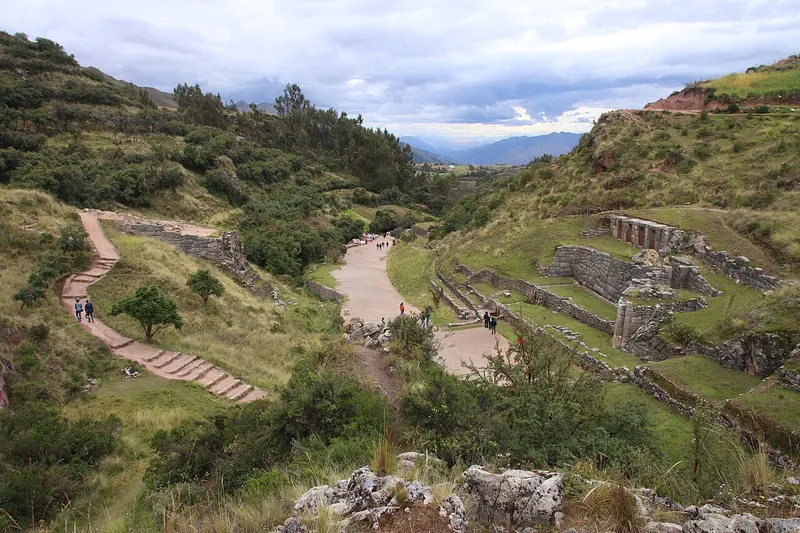
Písac isn't only a market. On the ridge high above the town sprawls the Inca site of Písac (P'isaq), one of the Sacred Valley's finest: vast curving terraces that fan down the mountainside, a ceremonial sector with fine temple stonework, water channels, and — cut into the cliff opposite — what is thought to be one of the largest Inca cemeteries known, its tombs pocking the rock face. The setting, with the valley dropping away on every side, rivals anything short of Machu Picchu itself.
Entry to the ruins is by the Boleto Turístico, the Cusco regional tourist ticket, rather than a separate gate fee — verify its current scope and price locally, as the Ministry sets these. You can reach the upper site by taxi up the switchback road and walk down through the terraces to the town, which is by far the easiest way at altitude, or hike up from the plaza if you're acclimatized and fit. The smart plan is ruins first thing in the morning, then down to the market for shopping and lunch once the heat and the crowds have arrived.
- The hilltop Inca ruins of Písac — terraces, temples and a cliff-face cemetery — are a Sacred Valley highlight in their own right.
- Entry is via the Boleto Turístico, not a standalone ticket; verify scope and price locally.
- Taxi up the back road and walk down through the terraces to spare your lungs at altitude.
- Do the ruins early, then the market — not the other way around.
Eating and the empanada oven
Písac is a pleasant place to break for lunch. The plaza and the lanes around it hold cafés and small restaurants — the town has long had a gentle bohemian streak, so you'll find good vegetarian and healthy-eating spots alongside the traditional menús. The local ritual worth seeking out is the bakery with the great adobe horno (clay oven): Písac is known for its empanadas and round breads pulled hot from wood-fired clay ovens, and watching the baker work the long peel is half the pleasure.
If you're combining Písac with the rest of the valley, it works neatly as a morning stop on a loop that continues to Ollantaytambo, or as the first leg of a Sacred Valley day out of Cusco. Either way, leave the heavy souvenirs for the journey back rather than lugging textiles up to the ruins.

Reading the textiles: a quick literacy
Part of what makes Písac rewarding is learning to read the weavings rather than just buying the prettiest one. Andean textiles carry meaning: the iconography woven into a manta or a belt — diamond patterns, zigzags, stylised birds, condors, lakes and rivers, the inti sun — is a visual language tied to the weaver's community, and pieces from different highland villages carry different motifs and palettes. A good vendor can often tell you which community a textile comes from, and that knowledge is one of the surest signs you're being sold the real thing rather than an anonymous import.
The other thing to learn is how to spot genuine handwork. Turn a piece over: a true hand-loomed textile usually looks as considered on the back as the front, with the pattern reading clearly on both sides rather than a tangle of loose threads. Natural-dyed yarns tend toward slightly irregular, organic colour, where machine-dyed acrylic is flatly, perfectly uniform and often unnaturally bright. The weave of handwork has tiny inconsistencies; perfectly even machine weave does not. None of this means the cheaper machine-made souvenirs aren't fun to buy — just buy them knowing what they are, and pay the real price for the real pieces.
- Patterns are a language — diamonds, birds, condors, the sun — and vary by highland community.
- A genuinely hand-loomed textile usually reads cleanly on both sides, not just the front.
- Natural dyes give slightly irregular, organic colour; machine acrylic is flatly uniform and often glaringly bright.
- Handwork carries tiny inconsistencies; perfectly even weave is a machine tell.
Common questions
The things travellers most often ask before heading to Písac. Treat ticket scope and prices as items to verify locally — the authorities set them and they change.
- Is it only on Sundays? No — there's a market most days now, but Sunday is the traditional, biggest and busiest day.
- How far is it from Cusco? Roughly an hour by road, at the Cusco end of the Sacred Valley.
- Can I bargain? Yes, gently — the asking price has room in it, but keep it friendly and fair.
- Is the alpaca real? Often not at the cheap end — very soft, very cheap knits are usually acrylic.
- Do I need a ticket for the market? No, the market is free; the hilltop ruins need the Boleto Turístico.
- Market or ruins first? Ruins early, market after — the stalls are at their best, and busiest, by late morning.
At a glance
The Písac essentials in one place. The character of the market is evergreen; ticket scope, prices and the exact market days can shift, so confirm them locally.
- What it is: a famous artisan and produce market in a Sacred Valley town about an hour from Cusco.
- Best day: Sunday for the traditional spectacle; a weekday for calm and softer prices.
- Best buys: handwoven textiles, alpaca knitwear, silver, ceramics — pay fairly for handwork.
- Pair it with: the hilltop Inca ruins above town, on the Boleto Turístico — do the ruins first.
- Money: bring small soles notes; bargain gently; buy from makers where you can.

Related guides

Pisac: Market Town, High Ruins & Valley Views
The Sacred Valley's eastern gateway — the famous artisan market, the spectacular cliffside ruins, the cafés and bohemian streak, and whether Pisac is worth a full day on the way to or from Machu Picchu.
Read guide
Pisac Ruins: Terraces, Temples & Cliff Tombs
How to visit the great cliffside Inca complex above Pisac — the ticket you need, the sweeping terraces, the Intihuatana sun temple, the cliff tombs, the steep hike from town, guide advice and how to pair the ruins with the market.
Read guide
What to buy in Cusco & the Valley
A buyer's guide to Cusco and the Sacred Valley — handwoven textiles, real alpaca, ceramics, chocolate and coffee, silver and jewellery — plus how to tell the genuine from the tourist-grade and shop in a way that helps the makers.
Read guideMore in Sacred Valley
6
Best Hotels in the Sacred Valley
A curated shortlist of where to sleep in the Sacred Valley before Machu Picchu — sorted by what each does best: shortest train day, gardens and acclimatization comfort, family space, honeymoon luxury and value.
Read guide
Chinchero: Weaving, Terraces & the High Plateau
The 'birthplace of the rainbow' on the plateau above the Sacred Valley — its living weaving tradition, the church built on Inca foundations, the terraces, the Sunday market, and how the new airport and a valley loop fit around it.
Read guide
Family Hotels in the Sacred Valley
Where families should sleep in the Sacred Valley before Machu Picchu — garden resorts with lawns and pools, family rooms, easy meals, low-altitude comfort and smooth train-day logistics.
Read guide
Hiring a Private Driver in the Sacred Valley
When a private driver beats a group tour in the Sacred Valley — the flexibility, the off-road plateau sites, families and luggage, citadel-morning transfers, and realistic route ideas with honest timing.
Read guide
Luxury Sacred Valley Hotels
The Sacred Valley's high-end lodges, spa retreats and honeymoon bases — destination hotels where pampering doubles as low-altitude acclimatization before Machu Picchu.
Read guide
Maras & Moray: A Half-Day Route
A practical half-day plan for combining Moray's circular Inca terraces and the Maras salt pans — from Cusco or a Sacred Valley base. Transport options compared, the best order, timing for light and crowds, tickets, altitude notes and how to add it to a bigger valley day.
Read guide